News
Serbia Votes as Student-Led Opposition Seeks to End Vucic’s Political Dominance
Published
1 month agoon
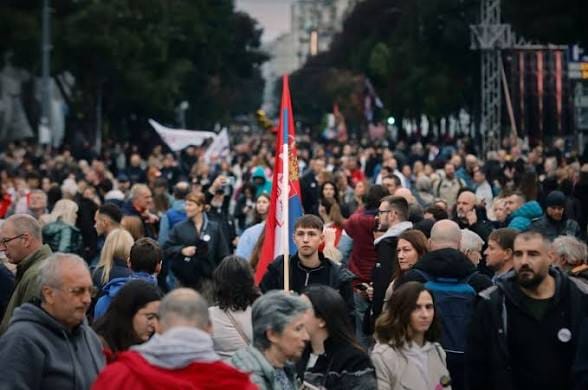
Serbia’s parliamentary election is testing the hold of longtime political heavyweight Aleksandar Vucic on power, with a student-backed opposition movement seeking to turn nearly two years of anti-government protests into electoral gains.
The poll, held on Sunday, October 25, 2026, pits the ruling Aleksandar Vucic – United Serbia bloc against Student List – Students Win, a political platform formed out of demonstrations that began in November 2024.
The protests attracted widespread participation across the country following the deaths of 16 people in the collapse of a concrete canopy at a renovated railway station in Novi Sad. The tragedy fuelled public anger over alleged corruption, government accountability and construction oversight.
Some opinion polls suggest the student-backed platform could compete closely with, or even outperform, the ruling party. However, Serbia’s polling environment has long faced questions over reliability and potential political bias.
The election is regarded as one of the country’s most closely watched contests in years, with preliminary official results expected late Sunday or early Monday.
Vucic, who has remained a dominant figure in Serbian politics since 2012, stepped down as president last month to pursue another term as prime minister, a position he has held twice previously.
The vote also follows a significant political shift in neighbouring Hungary, where Vucic’s ally, Viktor Orban, was defeated six months earlier.
The country’s relationship with Russia and its ambition to join the European Union are major issues confronting voters.
Serbia applied for EU membership in 2009, but progress towards accession has largely stalled during Vucic’s time in power.
His government has resisted European pressure to impose sanctions on Russia over its war in Ukraine, while Moscow has expressed dissatisfaction over reports that Serbian weapons and ammunition have reached Ukraine through intermediaries.
Vucic presents his foreign policy as an effort to maintain relations with both Western powers and Russia. Critics, however, argue that the approach has left Serbia caught between competing geopolitical interests.
The student-backed opposition has also adopted a cautious position on foreign policy, reflecting the diverse views of its candidates, who include academics, sports figures, trade unionists and professionals.
Although the movement has opposed sanctions against Russia, some analysts suggest the position could be intended to retain support among voters sympathetic to Moscow.
An opposition victory could nevertheless open the door to renewed discussions with Brussels over Serbia’s stalled EU membership bid and concerns about democratic standards.
Kosovo’s status remains another contentious issue. The territory declared independence from Serbia in 2008, but Vucic and many candidates on the Student List continue to insist that it belongs to Serbia.
The ruling party has focused its campaign on nationalism, infrastructure projects and economic performance, pointing to highway construction and foreign investment from European countries and China.
Serbia’s economy is projected to expand by nearly four per cent in 2026, according to estimates cited in the source report, outperforming the growth rate of several European economies.
The student-led opposition, meanwhile, has made corruption and accountability central to its campaign, drawing on public frustration over alleged misconduct within government institutions.
The Novi Sad railway station disaster in 2024 became a rallying point for protesters, who demanded answers over the deaths and called for greater transparency in public infrastructure projects.
The ruling party has portrayed its opponents as threats to Serbia’s national interests, while the student movement has faced hostile coverage from media outlets described in the source report as largely controlled by the governing establishment.
Concerns over the fairness of the electoral process have added another dimension to the contest, with opposition figures arguing that the governing party benefits from significant institutional advantages.
The ruling bloc has influence over the national electoral commission, most television stations with nationwide reach and state-owned companies. Critics say these connections can create an uneven environment for opposition candidates and expose public-sector employees to political pressure.
In its assessment of Serbia’s 2023 parliamentary election, the Organization for Security and Co-operation in Europe said the vote was technically well administered but marred by harsh rhetoric, media bias, pressure on public-sector workers and misuse of public resources.
The organisation also highlighted advantages enjoyed by the governing party that undermined equal competition. A later assessment found that some concerns had been addressed, although key issues remained unresolved.
The electoral commission registered 6,450,523 voters, a figure that prompted objections from opposition-associated members because it was close to Serbia’s estimated total population of around 6.5 million, including children. Members aligned with the governing party, who form the commission’s majority, prevailed in the dispute.
Voting arrangements for citizens living abroad have also attracted criticism. Changes requiring overseas voting to follow Serbian local time mean voters in countries such as Australia and the United States may have to cast their ballots overnight or in the early morning.
More than 100,000 Serbian citizens living abroad could influence the outcome if the contest proves as close as anticipated.
Beyond the immediate result, the election will test whether the student-led movement can convert its mass demonstrations into sufficient electoral support to challenge a governing establishment that has dominated Serbian politics for more than a decade.
Nelly Agwu is an educationist, a journalist, a Blogger, graduate of History. Very dynamic and a realist. A mouthpiece of the oppressed. Easy going and a Philanthropist.
You may like
President Tinubu Celebrates Atiku At 80
Smart December Spending Can Help Nigerians Avoid the January Financial Squeeze
2027: Tinubu May Lose Lagos, Oyo As Atiku, Obi, Makinde Target Other South-West States – Obaseki
Your Wife’s Money Is Hers Not Yours; Don’t Feel Entitled — Pastor Poju Oyemade Tells Men
Edo Roads Are Too Bumpy, Fix Them If You Want Me Back – Pastor Benny Hinn Tells Okpebholo
If I Decide To Keep Quiet, I Will Die In This Journey — Popular Prophet Cries Out For Help Over Drug Addiction
Tinubu Has Made Business Registration More Affordable – Seyi Law
You Must Buy Prayer Materials Before Entering My Church – Pastor Adom Kyei-Duah
ZARA ECOSYSTEMS CONSORTIUM AND SOUTH EAST DEVELOPMENT COMMISSION (SEDC)EXPLORE STRATEGIC DEVELOPMENT PARTNERSHIP
Sexual Assault Claims: ‘We Are Examining Video To Verify Its Authenticity Or AI — Daura Emirate Council
I Feel Pretty Foolish – Elon Musk Admits After Spending Nearly $500m on US Elections Won by Democrats
19-Year-Old TikToker Sentence To 5 Months In Prison, 10 Strokes Of Cane For Insulting Hisbah Commander
11 Die, 180 Hospitalised After Consuming Alcohol in India
US Names More Nigerians in ‘Worst of the Worst’ List
Court Bars Jimmy Odukoya From Acting As Fountain Of Life Church Senior Pastor
Bamayi’ Protest Escalates as APC Campaign Convoy Faces Attack in Gombe

Trending
-
News1 day agoZARA ECOSYSTEMS CONSORTIUM AND SOUTH EAST DEVELOPMENT COMMISSION (SEDC)EXPLORE STRATEGIC DEVELOPMENT PARTNERSHIP
-

News1 day agoSexual Assault Claims: ‘We Are Examining Video To Verify Its Authenticity Or AI — Daura Emirate Council
-

News1 day agoUS Names More Nigerians in ‘Worst of the Worst’ List