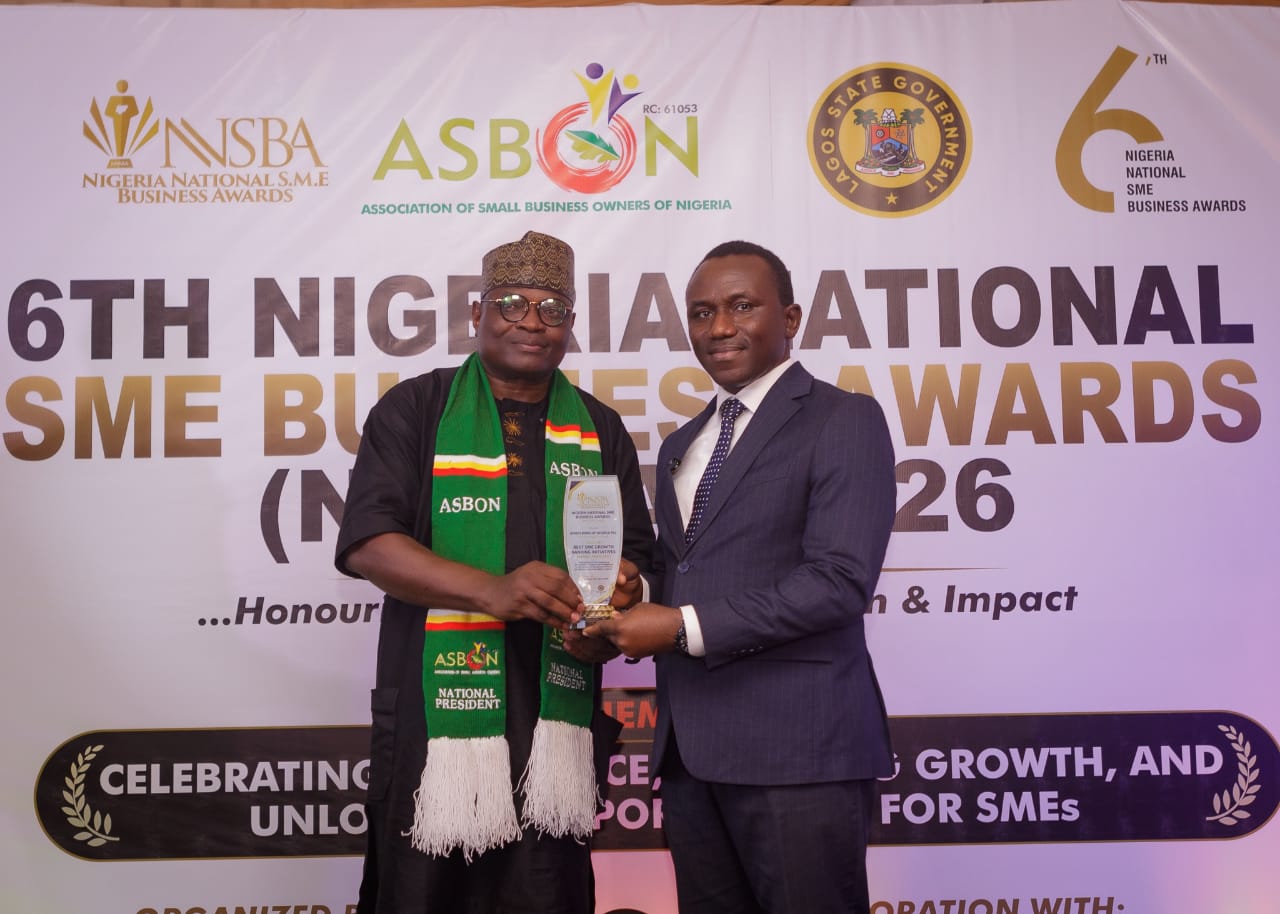
Union Bank of Nigeria has been named winner of the Best SME Growth Banking Initiatives Award (2025) at the Nigeria National SME Business Awards, organised by the Association of Small Business Owners of Nigeria (ASBON) in partnership with the Lagos State Government through the Ministry of Commerce, Cooperatives, Trade and Investment.
The recognition arrives at a moment when the relationship between Nigerian banks and Nigerian small businesses is being quietly redefined. Awards in this space have historically rewarded scale and product breadth. The ASBON criteria, by contrast, ask a more practical question: which banks are actually making it easier for entrepreneurs to operate?
WHY THIS AWARD, AND WHY NOW?
Across Nigeria, growth is no longer the only measure of success for a small or medium-sized enterprise. For most owners, success now looks like stability. Cashflow that holds up. Payments that clear without disruption. Financing that arrives in time to seize an opportunity rather than rescue a crisis. Operations that are not slowed by administrative friction.
That shift in what SMEs need has changed what they look for in a bank. The institutions earning their attention are the ones that take the daily reality of running a business in Nigeria seriously, not those with the longest catalogue of products. It is in that environment that the ASBON recognition reads as something more than ceremonial.
Union Bank’s SME work over the past year has been organised around a small number of practical priorities, and many of the issues SMEs cite as their biggest pain points sit at the centre of them.
FASTER ONBOARDING, MORE USABLE DIGITAL TOOLS
Account opening and customer onboarding have long been one of the slowest stages of business banking in Nigeria. For an entrepreneur trying to receive payments, pay suppliers, or qualify for a tender, days lost at this stage are days lost from the business itself.
Union Bank addressed this directly with enhancements to its Union360 platform and the rollout of a Straight-Through-Processing (STP) Digital Onboarding Platform. The intent was simple: cut the time between an SME deciding to bank with Union Bank and actually being able to transact. The improvements have meaningfully shortened onboarding, raised digital activity among SME customers, and brought in a notable cohort of new business clients.
Behind those improvements is a
recognition that Nigerian SMEs are increasingly multi-channel by default. A small retailer may take payments by transfer, POS, mobile money, and online checkout in the course of a single afternoon. The bank that supports them has to be reliable across all of those rails, not just the ones that photograph well in product brochures.
FINANCING THAT MEETS BUSINESSES WHERE THEY ARE
Access to credit remains the most frequently cited barrier for Nigerian SMEs, particularly for businesses without conventional collateral or a long paper trail of audited accounts.
Union Bank’s response has been less about loosening criteria and more about widening the range of evidence that counts.
Consistent transaction history, active account use, and clear cashflow patterns now carry meaningful weight in how the Bank assesses a small business. For a generation of entrepreneurs whose operations are real but whose paperwork is light, that is a material change.
The Bank’s SME lending over the review period reflected this orientation, with funding directed at working capital, inventory, equipment, and the kind of operational expansion that sits between mere survival and genuine scale.
THE HUMAN SIDE OF THE WORK
Digital infrastructure matters, but it does not replace the value of someone an entrepreneur can actually call.
Union Bank’s SME engagement is supported by a network of relationship managers, direct sales agents, and branches across the country. The Bank’s “Adopt, Engage and Grow” campaign was designed to reach SMEs at this human level, not as a once-a-year touchpoint, but as a sustained relationship that meets businesses where they are, both physically and operationally.
The approach reflects a basic truth about small business banking in Nigeria.
Entrepreneurs operate under pressure that is rarely visible from a head office. The institutions they trust tend to be the ones whose people understand that pressure, respond when it matters, and treat the relationship as ongoing rather than transactional.
UNION BANK OF NIGERIA AND ASBON
Union Bank’s recognition is also tied to its partnership with ASBON, through the SME Empowerment Challenge run jointly by the two organisations.
The Challenge encouraged entrepreneurs to open or reactivate business accounts, maintain proper transaction records, and develop structured plans for growth. On its surface, it was a campaign. In substance, it was an attempt to nudge a behaviour that Nigerian SMEs themselves often identify as one of the hardest to sustain: the discipline of running the business as a business, with clean books, separated finances, and a clear view of where it is going.
That discipline matters because it is the gateway to almost everything else. Loans, grants, supplier credit, partnerships, and public sector contracts all depend on a business being able to show how it actually operates. By building that habit alongside ASBON, Union Bank invested in something that outlasts any single campaign cycle.
WHAT THE AWARD ACTUALLY SIGNALS
There is a tendency to read awards as endpoints. This one reads better as a signpost. Nigerian SMEs are operating in one of the most demanding business environments on the continent. They are also, collectively, the largest source of employment in the country and the most direct route to broad-based prosperity. The banks that serve them well, with patient infrastructure, accessible financing, real human engagement, and a partnership posture toward the wider SME ecosystem, have a role to play that goes well beyond commercial performance.
Union Bank’s recognition at the ASBON SME Awards 2025 is, in that sense, an acknowledgement of a posture as much as a portfolio. The work it points to, faster systems, more accessible credit, sustained engagement, and a habit of building alongside SME institutions rather than around them, is the kind of work that compounds quietly over years.
For a bank, that is the most useful kind of award to win. Not the one that celebrates a moment, but the one that confirms a direction.